Urology
Diagnosis and surgical treatment of urological conditions in children
Overview
Paediatric urology in the Republic of Moldova began to develop as a separate field within paediatric surgery in the early 1960s, as it did worldwide.
The history of national paediatric urology can be divided into three stages:
Stage I – until 1974, patients with urological conditions were treated in the paediatric surgery unit.
In the 1960s, only patients with cryptorchidism, hydrocele and some mild forms of hypospadias were operated on. Gradually a group of specialists formed who treated various urological malformations: Z. Portnov – plastic surgery of the kidney and bladder, including vesicorenal reflux; B. Curajos and V. Dzero operated on patients with bladder outlet obstruction.
Moldovan paediatric urologists regularly presented their results at national and Union-wide conferences and congresses and were highly regarded. Their fine results are also reflected in the successfully defended doctoral theses of Z. Portnov (1967) "Vesicorenal reflux in children", B. Curajos (1970) "Cystourethrography and cystomanometry in diagnosing urological disease in children" and V. Dzero (1974) "Diagnosis and treatment of bladder outlet obstruction in children".
Stage II – 1974–1986.
The growing number of patients with urological diseases, and the particular needs of their examination and treatment, required a dedicated paediatric urology unit. At the insistence of Academician Natalia Gheorghiu, in 1974 one of the first paediatric urology units in the former USSR, with 40 beds, opened at the "E. Coțaga" Republican Clinical Children's Hospital. A. Muntean was appointed head of unit, working with B. Curajos, V. Dzero, I. Zaharia and N. Starciuc. Academician Natalia Gheorghiu and Associate Professor B. Curajos acted as consultants from the Department of Paediatric Surgery.
E. Salita, A. Buza and E. Gheţeul trained through internship and residency and worked as urologists.
All the urologists kept abreast of the latest achievements of urologists in Moscow, St Petersburg, Kyiv, Minsk, Baku, Kharkiv and other cities of the Union. Great support in training and developing staff came from Professors Yu. Isakov, V. Derzhavin, A. Pugachev, G. Bairov and N. Savchenko and from colleagues in Romania, Professor A. Pesamosca.
Over these years paediatric urology developed rapidly, and the unit performed virtually all reconstructive operations on the upper and lower urinary tract, including for hydronephrosis, duplex kidney, anti-reflux surgery, repair of bladder exstrophy, epispadias, hypospadias, etc.
Stage III – 1986–2007
With the opening of the Scientific Research Institute for Maternal and Child Health Care, the paediatric urology unit moved there with 60 beds. Young urologists L. Seu, J. Bernic (PhD), A. Curajos, researcher V. Roller and L. Rezneac (anaesthetist) began working there, with Associate Professor B. Curajos as consultant.
From 1988, I. Zaharia, a doctor of the highest category, was appointed head of unit.
The paediatric surgery clinic led by Eva Gudumac, Dr Hab. Med., professor, Academician of the Academy of Sciences of Moldova and Honoured Worker, trained paediatric urologists A. Iuhtimovschii, V. Şaptefraţi, J. Bernic and V. Roller, as well as adult urologists from the districts.
Alongside providing high-level care, the staff of the urology clinic often organised scientific and practical conferences in Chișinău and the districts for paediatricians and nephrologists on current issues in paediatric urology.
Theses successfully defended at the clinic include those of A. Buza (1993) and L. Rezneac (1997) "Comparative assessment of rational combined anaesthesia techniques in reconstructive urological surgery in children", and the habilitation thesis of B. Curajos (1997) "Diagnosis and differentiated surgical treatment of congenital posterior urethral stenosis and its consequences in children". In 1998, J. Bernic: "Diagnosis and treatment of complications of congenital malformations of the upper urinary tract in children".
The urology unit currently has 40 beds.
The unit has 5 doctors:
1 – head of unit Victoria Celac
4 – attending doctors of the highest category: Ion Zaharia, E. V. Gheţeul, L. N. Seu, A. B. Curajos and A. M. Revenco
The service is headed by Mr Boris Curajos – Dr Hab. Med., professor at the Department of Paediatric Surgery of the Nicolae Testemițanu SUMPh, Head of University Clinic No. 2 of Urology and Paediatric Nephrology, chief paediatric urologist of the Ministry of Health and Social Protection;
staff of the Nicolae Testemițanu State University of Medicine and Pharmacy: Jana Bernic – Dr Hab. Med., professor, Head of University Clinic No. 2 of Paediatric Urology, Nephrology, Surgery, Orthopaedics, Traumatology and Anaesthesia;
Vera Dzero – PhD, associate professor;
Victor Roller – researcher;
All the clinic staff have worked hard to introduce new diagnostic methods and surgical procedures, with encouraging results.
At first there were problems with treating hypospadias. Associate Professor V. Dzero learned the Duplay-Savchenko repair in Minsk and then introduced it in the unit, where it is still used successfully today.
Neurogenic bladder is a common and serious problem. Studies carried out in the clinic and in Moscow with Professors V. Derzhavin and V. Vishnevsky, where V. Dzero and I. Zaharia travelled, produced positive results in treating this condition.
Bladder exstrophy is another serious condition, and the clinic's staff are constantly looking for more effective treatments.
For the first time, our clinic used a formalinised graft for a small bladder.
After surgery, once the bladder had been formed, these children often still had urinary incontinence. A new technique for reconstructing the bladder neck was proposed, after which most children achieve continence (V. Derzhavin, B. Curajos).
There are also encouraging results in treating urinary infection and neurogenic incontinence, and especially organic bladder outlet obstruction such as meatal stenosis in girls and posterior urethral stenosis in boys. These conditions have been studied in the clinic for more than 20 years. A set of investigations has been developed to diagnose and treat obstruction and its consequences, and the operations are now considered routine.
For the first time, a radionuclide method of studying lower urinary tract urodynamics was developed, which greatly helps in choosing the right treatment.
The urethrotome developed by Dr A. Munteanu is especially important in treating urethral strictures. In the past, patients with congenital posterior urethral stenosis were operated on through a perineal approach, taking at least 1.5–2 hours with 3–4 surgeons, followed by at least 12–14 days in hospital. Now one surgeon performs the operation in 3–5 minutes, and children go home after 2–3 days.
In recent years the unit has used a new two-stage surgical treatment for abdominal cryptorchidism: first an artificial hernia is created, then orchidopexy with inguinal canal repair is performed (B. Curajos).
During heminephrectomy we routinely perform capsulotomy of the remaining moiety, with good post-operative results (B. Curajos).
For neuromuscular dysplasia of the ureter with grade V vesicorenal reflux, the Mebel ureteral reimplantation technique has been modified, with encouraging results.
For varicocele, the clinic performs the Ivanissevich operation as modified by Erokhin, which has virtually eliminated the common complication of lymphostasis.
Three doctoral theses are currently in preparation.
The clinic's staff have published more than 250 scientific works, a monograph and methodological materials, and regularly take part in scientific forums at home and abroad.
Together with Professor P. Mogoreanu, a new classification of pyelonephritis and acute kidney failure in children was developed (B. Curajos).
In recent years, paediatric urologists have worked actively with adult urologists and the Department of Urology (head of department A. Tanase).
In recent years the following new diagnostic and treatment methods have been introduced in the urology unit:
1. Renal angiography with computed tomography.
2. Static scintigraphy in the differential diagnosis of renal masses.
3. Measuring the calyx-to-parenchyma ratio to assess the effectiveness of surgery for hydronephrosis.
4. Indwelling bladder catheter in children with acute urinary infection caused by vesicorenal reflux.
5. Use of "Detrusitol SR" in treating hyperreflexic bladder.
6. Surgical treatment of epispadias – bladder neck and urethral reconstruction (Young procedure).
Case mix in the urology unit
No. — Condition
1. — Solitary kidney
2. — Duplex kidney
3. — Horseshoe kidney
4. — L-shaped kidney
5. — Renal ectopia
6. — Renal hypoplasia
7. — Renal cyst
8. — Multicystic kidney
9. — Polycystic kidney
10. — Hydronephrosis
11. — Nephroptosis
12. — Renal tumour
13. — Kidney stone
14. — Renal carbuncle
15. — Kidney injury
16. — Nephrosclerosis
17. — Renal malrotation
18. — Obstructive megaureter
19. — Refluxing megaureter
20. — Vesicorenal reflux
21. — Bladder exstrophy
22. — Bladder diverticulum
23. — Bladder stone
24. — Neurogenic bladder
25. — Hypertonic bladder
26. — Hypotonic bladder
27. — Distal urethral stenosis
28. — Posterior urethral stenosis
29. — Meatal stenosis
30. — Hypospadias
31. — Epispadias
32. — Urethrocutaneous fistula
33. — Urethrocele
34. — Urethral stone
35. — Adrenogenital syndrome
36. — Cryptorchidism
37. — Testicular agenesis
38. — Hydrocele
39. — Torsion of the appendix testis (hydatid of Morgagni)
40. — Varicocele
41. — Phimosis
42. — Concealed penis
43. — Short frenulum
44. — Testicular injuries
45. — Acute epididymo-orchitis
46. — Essential haematuria
47. — Epididymal cyst
48. — Spinal bladder
49. — Renal agenesis
50. — Chronic recurrent secondary pyelonephritis
51. — Chronic secondary cystitis
52. — Renal hydatid cyst
53. — Paranephritis
54. — Endometrial cyst
55. — Testicular injury
56. — Testicular torsion
57. — Testicular atrophy
58. — Paraurethral polyp
59. — Perineal paraurethral phlegmon
60. — Iatrogenic urethral injury
61. — Patent urachus
62. — Testicular tumour
63. — Orthotopic urethrocele
Surgical activity
No. — Condition
1. — Kidney reconstruction:
- Anderson-Hynes pyeloplasty
- antivasal repair
- ureterolysis
2. — Nephroureterectomy:
- kidney injury
- multicystic kidney
- renal hypoplasia
- obstructive megaureter
- non-functioning duplex kidney
- end-stage hydronephrosis
- vesicorenal reflux, megaureter
- Wilms tumour
- renal hydatid cyst
- giant renal cyst
3. — Heminephroureterectomy
4. — Excision of renal cyst
5. — Suturing of injured kidney
6. — Incision and drainage of renal carbuncle
7. — Pyelolithotomy
8. — Anti-reflux surgery
- Gregoir procedure
- Mobley and Leadbetter-Politano procedures
9. — Supravesical ureterectomy
10. — Epicystolithotomy
11. — Bladder diverticulum
12. — Ureterocelectomy
13. — Hypospadias:
- Stage I
- Stage II
- transverse meatoplasty
- "Gofre" operation
- partial circumcision
14. — Urethral fistula repair
15. — Distal urethral reconstruction (girls)
16. — Posterior urethral reconstruction (boys)
17. — Excision of the left internal spermatic vein
18. — Orchidopexy
19. — Excision of the processus vaginalis
20. — Circumcision
21. — Excision of the hydatid of Morgagni
22. — Funiculectomy
23. — Repair of concealed penis using local tissue
24. — Frenuloplasty
25. — Excision of epididymal cyst
26. — Suturing of scrotal wound
27. — Testicular detorsion
Unit phone 56-79-98
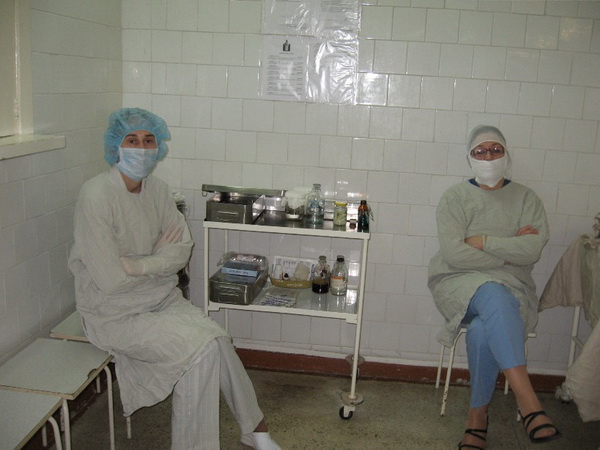
J. V. Bernic and V. G. Dzero in the operating theatre
Professor B. M. Curajos in the operating theatre