Orthopaedics and traumatology
Treatment of injuries and musculoskeletal conditions in children
Overview
The Orthopaedics and Traumatology Unit began work in 1973 at the Republican Clinical Children's Hospital, which now bears the name of its chief physician, "E. Coțaga". In 1986 the unit moved to the Scientific Research Institute for Maternal and Child Health Care. It has 60 beds. More than 1,800 children are treated and more than 1,100 operations performed every year. Two university clinics work within the unit:
· University Clinic of Paediatric Orthopaedics and Traumatology, headed by Professor P. T. Moroz, Dr Hab. Med.
· University Clinic of Spinal Surgery, headed by Professor N. G. Şavga, Dr Hab. Med.
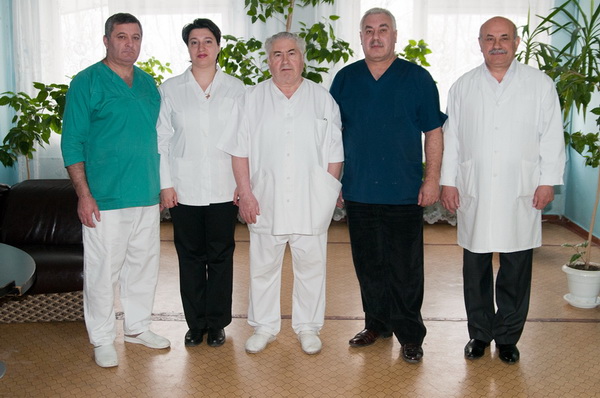
The unit team:
· Head of unit – V. Golub, PhD in medicine, orthopaedic and trauma surgeon, highest category
· Doctors:
N. Şcetinin – orthopaedic and trauma surgeon, highest category, head of unit from 1973 to 2010.
· A. Moraru – orthopaedic and trauma surgeon, highest category
· S. Carlic – orthopaedic and trauma surgeon
· V. Opincă – orthopaedic and trauma surgeon
· Iu. Sandrosean – PhD in medicine, orthopaedic and trauma surgeon, highest category
· M. Popa – orthopaedic and trauma surgeon, highest category
· F. Grin – orthopaedic and trauma surgeon
· S. Cojuşnean – orthopaedic and trauma surgeon
· I. Sîrbu – orthopaedic and trauma surgeon
Staff of the Department of Paediatric Surgery, Orthopaedics and Anaesthesia of the Nicolae Testemițanu SUMPh also work in the unit:
· Argentina Sandrosean – PhD in medicine, associate professor, orthopaedic and trauma surgeon, highest category
· N. Şavga – Doctor Habilitatus in medicine, associate research professor, Honoured Worker of the Republic of Moldova, orthopaedic and trauma surgeon, highest category
· L. Stati – PhD in medicine, associate professor, orthopaedic and trauma surgeon, highest category
Nurses working in the unit:
Ada Cocerva – senior nurse, highest category
Angela Huşanu – ward nurse, highest category
Ala Berco – dressing nurse, highest category
Aurelia Lapuşnean – dressing nurse, highest category
Aliona Surachi – ward nurse, highest category
Madlena Stati – ward nurse, highest category
Galina Bicherschii – ward nurse, highest category
Elena Guțu – ward nurse, 1st category
Mariana Verbiți – ward nurse, 2nd category
Alina Lupu – ward nurse, 2nd category
Rodica Popa – ward nurse,
Care provided in the unit includes:
· Diagnosis and conservative and surgical treatment of:
CONGENITAL MUSCULOSKELETAL ANOMALIES
– Hip dysplasia, congenital dislocations.
– Dysplastic coxa valga, congenital and acquired coxa vara.
– Arthrogryposis with hip dislocation, clubfoot and contractures of various joints.
– Chest wall deformities.
– Muscular torticollis.
– Congenital equinovarus clubfoot, metatarsus varus, valgus foot, calcaneus foot.
– Ectromelia with limb deformities and shortening.
– Amniotic band syndrome with constriction bands at various levels and limb deformities.
– Polydactyly, syndactyly, clinodactyly, congenital finger contractures, Notta's disease.
– Dislocations with congenital deformities of the upper and lower limb bones, radioulnar synostosis.
– Congenital, post-traumatic and dysplastic hand deformities such as Madelung's deformity.
– Congenital patellar dislocation.
– Congenital, post-traumatic and dysplastic axial deformities of the lower limbs such as tibia vara and valga.
– Accessory navicular, hallux valgus, myelodysplastic and paralytic foot deformities.
– Congenital pseudarthrosis at various levels.
– Cerebral palsy, with release of contractures through soft tissue and bone surgery.
– Congenital elevated scapula (Sprengel's deformity)
ACQUIRED AND POST-TRAUMATIC MUSCULOSKELETAL DEFORMITIES, TUMOURS.
– Perthes disease and other osteochondropathies.
– Slipped capital femoral epiphysis.
– Limb contractures after burns and injuries.
– Sequelae of poliomyelitis and osteomyelitis with dislocations at various levels, axial and foot deformities, and limb shortening.
– Post-traumatic deformities after limb fractures, post-traumatic pseudarthrosis.
– Fractures healing in malposition, for osteoclasis.
– Malunited intra-articular fractures with axial deviation and loss of function, for reconstructive surgery.
– Hip osteoarthritis, post-traumatic arthritis and synovitis.
– Benign tumours of bone and soft tissue, dysplastic bone lesions – osteochondromas, osteomas, osteoid osteoma, intraosseous lipomas, neurinomas, bone and muscle haemangiomas, ganglia and hygromas, chondromas, exostoses at various sites.
SPINAL PATHOLOGY
– Congenital and dysplastic scoliosis at various levels
– Cervical, thoracic and lumbar subluxation and instability
– Thoracolumbar osteochondropathy and dysplastic conditions with pain
– Juvenile kyphosis
– Spinal pain syndrome
– Complicated and simple fracture-dislocations at various levels
FRACTURES AND TRAUMATIC MUSCULOSKELETAL INJURIES
– Complicated and uncomplicated intra-articular fractures of the upper and lower limbs.
– Multiple trauma and combined injuries with fractures at various levels.
– Open and closed fractures of the upper and lower limb at epimetaphyseal and diaphyseal level (clavicle, humerus, forearm, hand, femur, lower leg, foot)
– Fracture-dislocations of the upper and lower limbs.
– Pelvic fractures.
Muscle injuries, foreign bodies in joints and soft tissue.