Premature infants
Care and feeding of premature infants
Overview
"Why does the sky clear so beautifully after a heavy, fertile rain?" asked the Romanian writer Lucian Blaga. And he answered: "To show that there is more joy in giving than in receiving."
I see that same brightness, born of the joy of giving, on my colleagues' faces every day, especially after a hard but successful fight for a human life. Of course it is hard: children need more love, tenderness and attention than adults. So those called to ease their pain and restore their health must have fine qualities of heart and a strong sense of responsibility for everything they do. Through their professionalism, daily dedication and results, the unit's staff confirm the well-known truth that a doctor's profession is hard and restless and demands total self-giving and competence.
The unit opened on 4 November 1982 with 30 beds for premature newborns with infections. Since 2013 the premature infants unit has been reorganised and has 41 beds, including 6 intensive care beds and 35 paediatric beds.
The first head of the unit was Ecaterina Boboc, doctor of the highest category. In 1983 the post was taken over by Larisa Albu, doctor of the highest category, who worked until 1998. The unit is currently headed by Liudmila Pinzari, paediatrician with residency in neonatology, doctor of the highest category.
The unit is located in a two-storey building and has 12 mother-and-baby rooms, each for 2 mothers
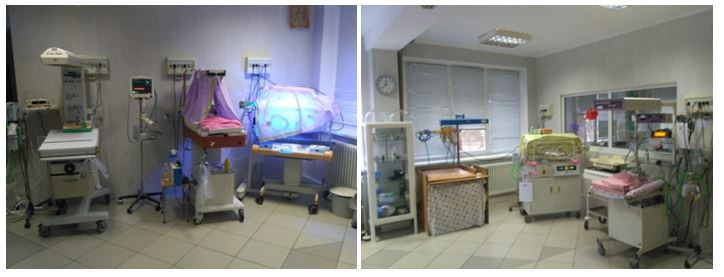
The intensive care section consists of 3 rooms with special equipment for emergency care:
From June 2007 to 2014, through the Moldovan-Swiss perinatology project and the UNICEF office (a project supported by the European Bank), the intensive care services of the Level III PMSI IMC and 3 Level II perinatal centres were equipped for the care, monitoring and diagnosis of premature babies
The unit, especially its intensive care section, provides round-the-clock emergency care to premature babies, newborns with medical conditions transferred by the AVIASAN service and infants in the neonatal period. It monitors and cares for babies with a birth weight from 500 g (sometimes for long periods, about 3 months), mainly transferred from the maternity Neonatal ICU.
These results would not have been possible without the steady growth of staff professionalism and the introduction of new scientific methods and modern diagnostic and treatment technologies. Year after year the unit becomes better equipped. The sad days of carrying oxygen cylinders by hand for fragile patients are long gone – the unit is now connected to a central oxygen supply. We have programmable incubators that maintain and regulate temperature according to the baby's weight, automated infusion pumps, pulse oximeters measuring pulse and blood oxygen, and cardiac monitors tracking pulse, breathing, blood pressure and temperature. The ultrasound machine allows 3D bedside scanning of organs and systems.
Since 2008 the Republic of Moldova has had a continuous follow-up service for high-risk newborns (Ministry of Health Order No. 118 of 19.02.2010), which provides regular assessment of the neurodevelopment and physical health of enrolled children and referral to Early Intervention Services when a high risk of neurodevelopmental problems is found.
The follow-up centre is equipped with medical devices (ultrasound, EEG, ophthalmoscope, audiometer) and standardised neurological assessment tools – the BINS test (Bayley Infant Neurodevelopmental Screener) and the Bayley Scales of Infant and Toddler Development, used to compare the child's performance with developmental norms for their age (in months). Staff have been trained in neurological assessment, testing, physiotherapy, EEG, cranial ultrasound and cardiac Doppler.
Structure of the centre
Follow-up room
Those who benefit from the Neonatal Follow-up Centre: premature babies with a birth weight under 1,500 g, babies who needed CPAP or mechanical ventilation, and those with hyperbilirubinaemia, neonatal seizures, severe fetal growth restriction, grade III–IV IVH, chronic lung disease, retinopathy of prematurity, abnormal neurological status at discharge, Sarnat stage II–III HIE or hearing problems.
The unit's successes are thanks to 5 doctors of the highest category in the general section and 4 doctors in intensive care, 27 nurses (7 of the 2nd category and 20 of the highest category) and 12 orderlies.
Contact and location
Location
Located in a two-storey building with 12 mother-and-baby rooms, each for 2 mothers