Newborns No. 1
Care for healthy newborns alongside their mothers
Overview
Unit
NEWBORNS
"People who turn suffering into joy"
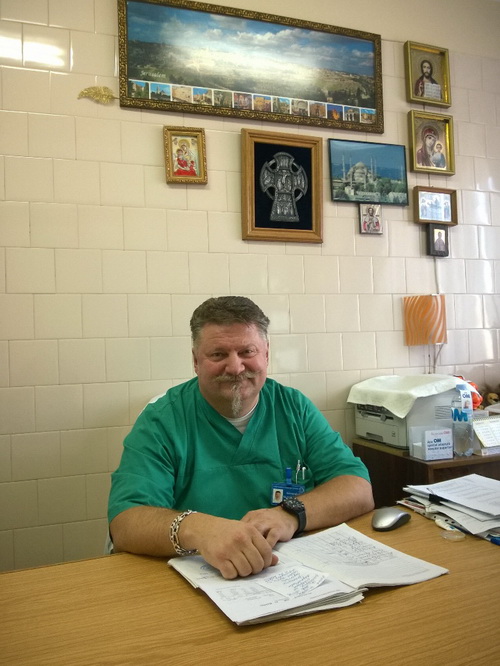
Alexandru Magulciac – head of the Neonatal Unit
Through everything it is today – its staff, professionalism, atmosphere, dedication and results – and everything it has been throughout more than thirty years of history, the Neonatal Unit of the Mother and Child Centre confirms the well-known truth that medicine is one of the greatest virtues of our people.
The Neonatal Unit began work almost 35 years ago, in 1981, as an 80-bed physiological newborn unit within the Maternity of the Centre for Maternal and Child Health Care. The first steps in specialised neonatal care were taken by the head of unit, Irina Barahovici, together with senior nurse Valentina Serantiuc.
Since 1988 the physiological unit has been part of the Scientific Research Institute for Maternal and Child Health Care.
Following the reorganisation of the institution by Ministry of Health Order No. 88 of 01.02.2013 "On the PMSI Institute of Mother and Child", a new staffing structure, organisational chart and Regulation were approved. Statistical data and indicators from recent years formed the basis of the decision to reorganise some units.
The unit team
The Neonatal Unit was thus created by merging the physiological newborn unit and the newborn observation unit
Over the years the unit has been led by
04.11.1981 – 31.12.1982 – Irina Barahovici
01.01.1982 – 01.10.1999 – Lidia Ciobanu
1999 – 2011 – Ludmila Ciocîrla
01.03.2013 – present – Alexandru Magulciac
The unit provides round-the-clock care and emergency treatment for premature babies, newborns and infants in the neonatal period.
The Neonatal Unit is spread over 5 (five) floors. Its staff care for newborns in two delivery suites with operating theatres and in two postnatal wards.
Rodica Ţurcan – senior nurse
Care is provided by staff trained in modern technologies for emergency newborn treatment and neonatal care. Newborns stay in separate rooming-in rooms with their mothers, who take an active part in their care under the close supervision and with the help of the unit's staff.
The unit can accommodate up to 110 newborns. Admission route: babies are admitted from the two Level III delivery suites of the PMSI IMC.
Over the years, thousands of children from every corner of the Republic of Moldova have been cared for by the unit's staff. Thousands of lives saved through skilled treatment. Thousands of destinies – a noble response to the calling of the people who work here.
Ludmila Oclanschi – coordinating neonatologist
Throughout its history the unit has been a centre for introducing new scientific methods and innovations and modern diagnostic and treatment technologies. Year after year it has become better equipped. Today the days of carrying oxygen cylinders to patients are just a memory – the unit is connected to a central oxygen supply. It now has programmable incubators that maintain and regulate temperature according to the baby's weight; automated infusion pumps; pulse oximeters measuring pulse and blood oxygen; and modern monitors that track heart function, breathing, body temperature and blood pressure.
From left to right: Irina Pîntea, coordinating neonatologist, and Angela Tanasii, nurse
The unit's great wealth has always been its true professionals. Watching the doctors and nurses of this unit at work, you fully understand the most important lesson life can teach: the pain in the world depends on us, and it is up to us – especially medical staff – whether we can ease it and turn it into joy.
We should remember with special respect the dedicated work of those who gave this unit long years of their lives and effort – doctors Lidia Ciobanu, Lidia Domentii, Emilia Darie and Irina Pîntea, and nurses Eugenia Pancișchina, Ana Mașirovscaia, Anastasia Melnicenco, Tatiana Pîrnău, Silvia Chistrugă, Galina Gorea, Svetlana Poian, Svetlana Rojanița and others.
Many doctors who are now renowned specialists have been part of the Neonatal Unit at various times: Ninel Revenco, professor, now Deputy Director for Research, Innovation and Technology Transfer of the PMSI IMC; Alexandru Voloh, PhD, associate professor; Elizaveta Curteanu; Vitalie Cotorcea, now head of the Ultrasound Perinatology Unit; Ludmila Ciocîrla, associate professor in the Department of Neonatology; Ludmila Oclanschii and Galina Scerbacova, assistant lecturers in the Department of Neonatology; Ludmila Pritula, Ludmila Anton, Valeriu Grigori, Ana Savciuc, Petru Laur, Serghei Josanu and Valeriu Gorodisteanu.
Lidia Domenti, neonatologist
The Neonatal Unit is a modern centre of medical science and practice with links and collaborations with prestigious similar institutions in France, Switzerland, the Netherlands, Ukraine, Romania and elsewhere.
Over the years, many newspapers and magazines have written about the unit and radio and TV programmes have been made, but the most precious gratitude has always come from those who, thanks to the care they received in the Neonatal Unit, are now fulfilling their dreams.
Seeing the immense effort and titanic work put into saving children's lives over a third of a century, you fully realise that nothing in the world is more lasting than a good deed. The work done here every day, year after year, is not only good – it is truly immortal.
Elena Sîrbu, nurse
Through years of work, the Neonatal Unit has achieved great things that have earned it a place of honour in the history of the Mother and Child Centre and of medicine in general.
Emilia Darii, neonatologist
The Neonatal Unit's work
is assessed against the following quality indicators.
Indicator
1. Proportion of newborns placed skin-to-skin during the first hour after birth (≥60 minutes).
2. Proportion of newborns given vitamin K within the first 2 hours of life.
3. Rate of newborns breastfed early, within the first hour of life.
4. Rate of newborns formula-fed for absolute and relative indications
5. Proportion of newborns exclusively breastfed at discharge from the maternity unit.
6. Proportion of newborns for whom "warm chain" requirements were met
7. Proportion of preterm births (≤34 weeks) given glucocorticoids (to prevent RDS)
8. Proportion of births monitored by a neonatologist.
9. Proportion of newborns who developed a hospital-acquired infection ≥48 hours after birth
10. Number of documented training sessions (approved by local orders) for medical staff
11. Proportion of newborns with an Apgar score ≤6 at 5 minutes
12. Newborns who received "A-B-C-D" resuscitation steps
13. Proportion of newborns
14. Proportion of babies with fetal growth restriction
15. Proportion of newborns who lost more than 15% of body weight
16. Proportion of placentas examined by pathology
17. Proportion of newborns given ophthalmia neonatorum prophylaxis
18. Rate of meconium aspiration syndrome among all births
19. Rate of newborns of mothers with diabetes
20. Proportion of newborns screened for phenylketonuria
21. Rate of newborns born to mothers with tuberculosis, AIDS, syphilis, hepatitis C, etc.
22. Rate of newborns who stayed with their mother in the maternity unit
23. Proportion of newborns with congenital anomalies detected on ultrasound
24. Incidence of congenital anomalies
25. Perinatal mortality rate
26. Early neonatal mortality rate
27. Early neonatal morbidity rate
28. Haemolytic disease of the newborn rate
29. Birth injury rate
30. Proportion of newborns transferred from the unit to stage II care
31. Proportion of newborns admitted to the unit with hypothermia.
32. Proportion of newborns admitted to the unit with hypoglycaemia.
33. Proportion of newborns vaccinated against hepatitis B
34. Proportion of newborns given BCG vaccination
35. Proportion of pregnant women from pathology wards who attended "Mothers' School" courses
Tatiana Sîrbu, nurse
Parascovia Forostovschii, nurse
Contact and location
Location
Located on 5 (five) floors.