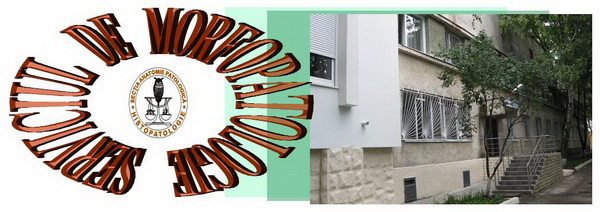
Pathology service
Histopathological and cytological examination
Overview
Head of service – pathologist, PhD in medicine
Vergil Petrovici
Contacts
Pathology and Cytopathology Service (paediatrics, obstetrics and gynaecology)
93 Burebista St., Chișinău, MD 2062
Tel. +373 (22) 52-37-60; e-mail: patolog.imsic@gmail.com
Purpose. To study the morphological features of disease processes arising during human development – formation, growth, maturation and the reproductive years – and to detect precancerous and cancerous changes early through comprehensive histopathology and cytopathology.
Brief history. The Pathology (Anatomical Pathology) Service was set up in 1970 as the Republican Paediatric Anatomical Pathology Service, based at the mortuary of the "Em. Coţaga" Republican Clinical Children's Hospital. When the PMSI IMC was founded (1983, then the Republican Centre for Maternal and Child Health Care), the service was reorganised as the Central Department of Anatomical Pathology (CDAP) for paediatrics, obstetrics and gynaecology, with histopathology diagnosis and mortuary sections.
The service's history records the highly professional work of the pathologists who led it – Galina Vaţuro (1970–1985) and Nina Salita (1985–1990) – and the fruitful contribution of the chief specialist in paediatric pathology Professor Ion Fuior (1975–2008), Associate Professor Gh. Cernocan (1995–2001), Dr Vasile Rusu (2006–2014), senior technician Ludmila Corsucova and the laboratory team (1977–1999): respected figures in pathology who helped organise and develop the CDAP and expand histopathology in medical practice.
Thanks to its extremely varied and complex case mix, the CDAP became an important diagnostic and advisory centre in its field. Since 1985 it has been a clinical base of the Nicolae Testemițanu SUMPh for training pathologists and histopathology laboratory staff. In 1998 the Republican Scientific Advisory and Methodological Centre was set up on the basis of the CDAP and the IMC Scientific Laboratory of Pathology, coordinated by the head of the laboratory, Ion Fuior (1998–2008), to improve paediatric pathology diagnosis across the country. Since 2012, under Ministry of Health Order no. 722, the CDAP has been reorganised as the IMC Pathology Service for paediatrics, obstetrics and gynaecology.
Structure. The Pathology Service has three diagnostic sections and one records section, in a separate building with 750 m² of usable space and 33 functional rooms:
- Histopathology section
- Cytopathology section
- Mortuary section
- Registry (reception) and archive
The sections are led and coordinated by head of service Vergil Petrovici; the laboratory technicians are led by senior technician Svetlana Cecoltan, and the auxiliary staff by housekeeping nurse Svetlana Movilianu.
Areas of work and staff. The Pathology Service provides diagnosis in obstetric, gynaecological and paediatric pathology.
The service currently has a team of 24:
- 8 pathologists and 2 cytopathologists, 5 of them with a research degree;
- 8 laboratory technicians with secondary specialist training in histopathology and cytopathology;
- auxiliary staff – 2 mortuary attendants and 4 laboratory assistants.
Equipment. The diagnostic sections use automated and manual histological processing. Since 2012 they have had high-performance equipment: the "Diapath" automated tissue processing and paraffin embedding system and the "Raffaello" automated staining line for histology and cytology slides (Italy); MC-2 microtomes (Russia) cutting sections of about 3–4 µm; and Nikon Labophot-2 (Japan) and Carl Zeiss (Germany) microscopes. Thanks to modern technology, processing time has fallen significantly: about 65% of cases are examined and reported within 24–36 hours.
Diagnostic methods. Pathology testing is of a high standard; staff are trained in theory and practice in modern techniques, including rapid intraoperative frozen-section diagnosis. Histology uses classical and histochemical methods. In 2012, working with the IMC Scientific Laboratory of Pathology, the service developed and introduced immunohistochemistry in clinical pathology diagnosis.
Laboratory team: Maia Grechin and Maria Loghin – processing and preparing frozen sections for rapid diagnosis and paraffin samples
Laboratory team: Olesea Doncilă and Natalia Marin – processing, trimming and automated and manual staining of histology and cytology slides, led by senior technician Svetlana Cecoltan.
Clinical diagnostic work. Clinical pathology involves gross and microscopic examination of tissue obtained through diagnostic procedures, minimally invasive and invasive surgery, obstetric procedures in childbirth, and spontaneous and induced abortions. Histology is widely used for pathology of the products of conception and the placenta, and cytopathology for the cervix and vagina and the uterine cavity – smears, aspirates, brush biopsies and colposcopy.
Histopathology section
(part of the service since 1978)
Coordinator: Dr V. Petrovici – pathologist, PhD in medicine
Staff: 6 pathologists; 4 laboratory technicians; 2 laboratory assistants.
Ecaterina Nedbailo
Pathologist
Work includes:
a) histological diagnosis of biopsy material: cervical and vaginal biopsies, digestive, tracheobronchial and urogenital tract biopsies; needle biopsies of the liver, kidney, testis and skin; wedge biopsies, excisions and enucleations of tissue and lesions at various sites
b) gross and microscopic diagnosis of disease in complex surgical specimens, segments and organs removed at surgery, placentas in premature births, feto-placental malformations, etc.
c) gross and microscopic diagnosis of material obtained by curettage or aspiration of the uterine cavity in metrorrhagia, menorrhagia, etc., and of products of conception in pregnancy loss, etc.
d) microscopic examination of histological slides using stains such as haematoxylin-eosin, picrofuchsin (van Gieson), Sudan III, azure-eosin (bacterioscopy) and, if needed, orcein, Masson's trichrome, alcian blue, Congo red, Bielschowsky-Gross silver impregnation, etc.;
e) diagnosis in stages: rapid intraoperative cytopathology and frozen-section diagnosis, then final histopathology.
Cytopathology section
(part of the service since 2012)
Svetlana Cecoltan
Medical laboratory technician
Coordinating technician in cytopathology
Coordinator: Svetlana Cecoltan – biologist, medical laboratory technician specialising in histo- and cytopathology
Staff: 2 cytologists; 1 laboratory technician; 1 laboratory assistant
Work includes:
a) cytomorphological examination of cervical and vaginal smears for screening
b) cytomorphological examination of smears from erosive and ulcerated surfaces, wounds and fistulas
c) cytomorphological examination of cervical and vaginal colposcopy material and cervico-uterine aspirates;
d) cytopathology using Papanicolaou and Romanowsky-Giemsa stains
Mortuary section
(set up with the service in 1970)
Coordinator: Ștefan Samciuc – pathologist
Staff: 2 pathologists; 2 laboratory technicians; 2 mortuary attendants
Ștefan Samciuc
Pathologist
Coordinating doctor for the mortuary
Work includes:
a) gross and microscopic diagnosis through comprehensive post-mortem examinations for deaths in the prenatal, perinatal, infant and post-neonatal periods;
b) histological examination of tissue samples taken at post-mortem and of placentas, for deaths at various stages of child development, in the postnatal period and in gynaecological disease;
c) cytopathology of imprints taken at post-mortem and of tissue samples for rapid diagnosis, and taking samples for bacteriology and bacterioscopy (where fungal or bacterial infection is suspected) to guide the gross diagnosis in uncertain cases;
d) identifying shortcomings and discrepancies in the clinical diagnostic process and taking part in quality reviews of that process in the relevant committees and clinical-pathological conferences;
e) mortuary work and care of the deceased (washing, embalming, cosmetic care, dressing), with release from the Pathology Service of the PMSI IMC
f) independent (repeat) review of deaths at the request of the patient's legal representatives, the management of other PMSIs, health insurance companies, etc.
Most of the diagnostic work consists of histopathology on living patients – 71.8–89.9% of the service's diagnostic activity each year, averaging about 38,269 histology and cytology tests, most of them archived as paraffin blocks and medical records at the service.
Registry and archive team: laboratory technician Galina Rotari and housekeeping nurse Svetlana Movilianu
In recent years the Pathology Service team has achieved important results by introducing diagnosis of gastrointestinal and hepatobiliary disease through endoscopic biopsy and liver needle biopsy, including in parasitic and infectious disease, and of kidney disease through renal needle biopsy.
National interdisciplinary collaboration
IMC Scientific Laboratory of Pathology
"Surgical Infections in Children" Laboratory and the Department of Human Anatomy of the SUMPh
Pathology input (chapters and sub-chapters) for research in obstetric, gynaecological and surgical pathology, nephrology and other fields.
National and international projects:
"Diagnostic Techniques in Paediatric Renal Diseases", Institutional Partnership, Swiss National Science Foundation;
"Morphological and clinical aspects of the heart valves and large coronary arteries", Moldova–Belarus
Practical, research and teaching work
Pathology examination is mandatory: it is the official record of the organ and tissue disease process, establishing its structural origin, nature and activity.
The results of the service's diagnostic work and interdisciplinary collaboration are reflected in 140 scientific papers in national and international medical journals, including 4 methodological guides, co-authorship of 2 monographs, 2 invention patents, 12 innovation certificates and 4 copyright certificates, as well as presentations at national and international conferences and symposia and chapters in teaching materials.
The staff of the Pathology and Cytopathology Service treat colleagues from other specialties, patients and relatives with respect and keep all pathology findings strictly confidential!
THANK YOU FOR VISITING THE PATHOLOGY AND CYTOPATHOLOGY SERVICE PAGE!
Contact and location
Ward phone